
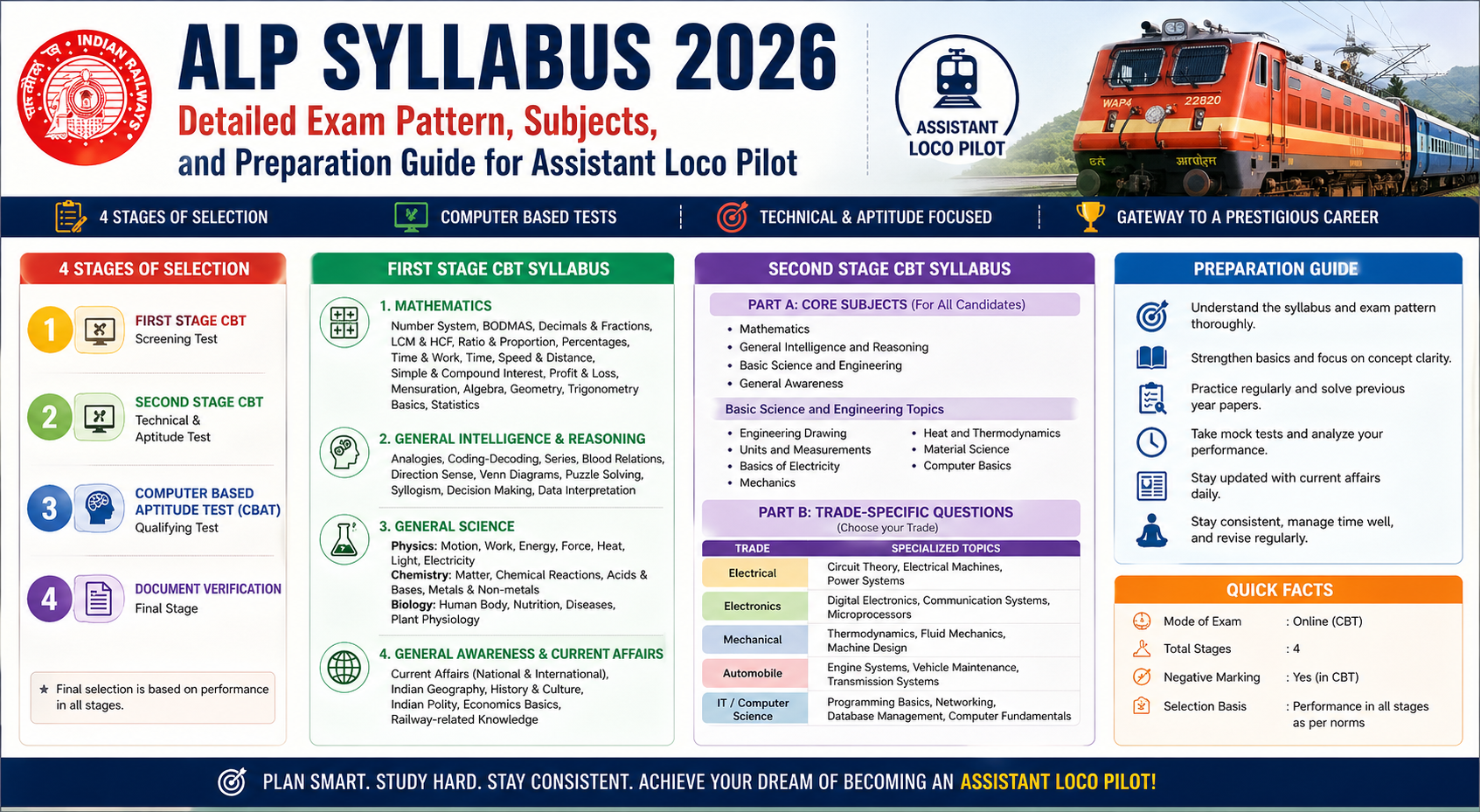
The syllabus for the Assistant Loco Pilot (ALP) is released by the Railway Recruitment Board and helps assess the various skills of candidates that are needed to run trains and other functions of Indian railways, structured at different levels. We provide a detailed smart, step-wise dissection of the ALP syllabus for aspirants who wish to excel with clarity, precision & strategy. All the important topics, subject weightage and preparation strategy that are required to top.
Overview of ALP Examination Structure
The ALP recruitment process is a multi-stage tested for your technical, reasoning ability and domain knowledge. The stages include:
- First Stage CBT (Computer-Based Test)
- Second Stage CBT
- Computer-Based Aptitude Test (CBAT)
- Document Verification
We shall discuss the separate syllabus and assessment pattern of each stage in detail.
RRB ALP Exam Pattern CBT
| Subject/Section | Number of Questions | Number of Marks | Duration |
| General Intelligence and Reasoning | 25 | 25 | 60 Minutes |
| Mathematics | 20 | 20 | |
| General Awareness | 10 | 10 | |
| General Science | 10 | 10 | |
| Total | 75 | 75 |
First Stage CBT Syllabus
The syllabus of the First Stage CBT is a type of screening test which assesses a candidate’s ability to demonstrate basic knowledge, aptitude and problem solving skills. It is divided into four broad heads, viz., Mathematics, General Intelligence and Reasoning, General Science, and General Awareness with Current Affairs. These sections collectively evaluate the complete competence required for the Assistant Loco Pilot exam.
1.Mathematics:
In this section, numerical ability and calculations are tested. Number System, BODMAS rules, Decimals and Fractions, LCM and HCF ratio and Proportion percentages Time and Work Time Speed Distance Simple Interest Compound Interest Profit Loss mensuration Algebra Geometry basics of Trigonometry Statistics Proficiency in these areas can only be attained by having a thorough grip on fundamental arithmetic concepts and efficient calculation techniques, which is the key to securing top marks.
2. General Intelligence and Reasoning
The General Intelligence and Reasoning section tests the logical thinking, analytical ability, and decision-making skill level of a candidate. This section includes analogy type questions, Coding-Decoding questions, Number and Alphabet Series based problems, Blood Relations Questions, Direction Sense Questions, Venn Diagrams Problems, Puzzle Solving Related questions (like Arranging different students or people with respect to their ranks and marks), Syllogism types of problems (conclusion based question out of one or two statements) along with Decision Making Based Questions as well as Data Interpretation Section. So if one practices this section regularly and strategically then speed, accuracy and solving higher difficulty problems becomes a cakewalk.
3. General Science
The syllabus for the General Science section is similar to what students study at the matriculation level in subjects such as Physics, Chemistry and Biology. The important topics in Physics include Motion, Work and Energy, Force, Heat, Light and Electricity. The core chemistry subjects include Matter, Chemical Reactions, Chemistry of Acids and Bases, Biology Circle (Human Body and Nutrition), Diseases, Plant Physiology — the list goes on. To score good marks in this section, one should have a command over these scientific concepts and principles.
4. General Awareness and Current Affairs
Last is General Awareness and Current Affairs which assesses a candidate’s awareness and general knowledge of the recent happenings around the world. It comprises of current affairs national as well as international, Indian geography history culture and polity, economic basics along with railway-oriented questions. Every time you read, the better is your performance in this section (as long as it does not need a dedicated reading of some specific books), …to get out of this power primitive way …the more updated you are on day to day affairs, the more information every question will require…questions can challenge your knowledge and force you to connect at least two bits of variable.
The First Stage CBT syllabus as a whole follows the right strategy that combines conceptual clarity, firm grip with practice and awareness of recent developments in all four sections.
Read Also: UPSI Vacancy | CCC Online Form
Second Stage CBT Syllabus
| Section | Topics Covered |
|---|---|
| Mathematics | Number System, BODMAS, Percentages, Ratio & Proportion, Time & Work, Profit & Loss, Algebra, Geometry, Trigonometry, Statistics |
| General Intelligence and Reasoning | Analogies, Coding-Decoding, Series, Blood Relations, Direction Sense, Venn Diagrams, Puzzle Solving, Syllogism, Data Interpretation |
| Basic Science and Engineering | Engineering Drawing, Units and Measurements, Basics of Electricity, Mechanics, Heat and Thermodynamics, Material Science, Computer Basics |
| General Awareness | Current Affairs, Indian Geography, History, Polity, Economics, Railway Knowledge |
Computer-Based Aptitude Test (CBAT)
CBAT: Qualifying stage for the measuring of cognitive and psychometric abilities It includes:
- Memory Test
- Concentration Test
- Perception Test
- Spatial Ability
- Depth Perception
Alp syllabus This stage is important in order to assess mental alertness and decision-making capacity, which forms part of the operational skills required for railway work.
Eligibility Criteria for ALP (Assistant Loco Pilot)
Eligibility criteria for ALP To apply, khat eshe sab kuch aisa identity ki jiese kisi b bharti/kaam main including educational qualification ki quate imtihana hona chahiye… jitwen je uno lega jaise age limit aur physical standards nahi. It is imperative to know these parameters before going for the examination.
Educational Qualification
Candidates should have Matriculation / equivalent from recognized board. Additionally, they should have an ITI passing certificate in similar trades in NCVT/SCVT affiliated institutions. Or candidates with a Diploma / Degree in Engineering in any one of the following streams, i.e., Mechanical, Electrical, Electronics, or Automobile disciplines. Technical Qualification should be in accordance with the trade requirement as mentioned in notification.
Age Limit
However the minimum age fixed is eighteen years and maximum upwards of thirty years. But there is also age relaxation for reserved categories as per government rules:
- OBC candidates: 3 years relaxation
- SC/ST candidates: 5 years relaxation
- PwD candidates — Further relaxation by norms
Nationality
Candidates have to be citizens of India. Government guidelines may also say certain subjects from Nepal or Bhutan or Tibetan refugees could be also qualified.
Medical and Physical Standards
Candidates must possess the standard medical fitness criteria prescribed for the Assistant Loco Pilot position. This includes:
Should have good vision, eyesight (A-1 medical standard is usually desired)
Fitness to perform operational duties
Conditions likely to adversely affect the performance of the functions relating to railway duties
Number of Attempts
Candidates can apply as many times as they want, but must be within age limit.
Other Requirements
Candidates must have documents & certificates validating their eligibility with educational qualifications, identity proof, and category certifications.
ALP Syllabus Preparation in Detailed Strategy Format
It is imperative that the preparation plan for ALP syllabus to be a well-formulated one.it is because of this uniqueness that this test has become an extreme competitive stage. Preparation Routine should start with developing a good fundamental concepts on all subjects particularly Maths, General Science & Reasoning as these are the main areas of the exam. Candidates should have conceptual clarity and not rote learning as it helps in solving the questions accurately and boosts confidence.
Another equally significant area is speed and accuracy, as the exam is time-bound. Solving Previous Year Question Papers / Mock Tests tutotrial regularity ensures a good idea of exam pattern, time management and weak subjects therefore these resources work together to give the final touch in exams prep for students preparing for IELTS. Through analysing the performance test-wise, candidates can work only on those sections where they are not proficient enough.
Word of caution: During the second stage, focus should be in technical subjects of the candidate’s trade. Candidates need a thorough knowledge of trade-related concepts with reference to standard textbooks and applications wherever necessary, as Part B is critical in the selection process and requires steady daily time commitment to enhance technical knowledge.
Keeping tab with current affairs and G.K is also an important part. Candidates must to gain the habit of reading newspaper like hindi or english on magazine/journals, or online reliable sources for latest updates related to National, Global issues and Railway Related News. It guarantees a better performance in the General Awareness section and removes the last minute preparation pressure.
Common Mistakes to Avoid
- Neglecting fundamental principles in Mathematics and Science which results in poor problem-solving skills
- Insufficient conceptual understanding and memorization as the main tool
- Forgetting to study the Current affairs & general awareness which leads to easy marks loss.
- Underestimating the high significance of technical matters for the second stage
- Failure to Practice Mock Tests & Previous Year Papers Properly
- Ineffective demo & exam time management in both preparation and exam
- Not revising the given topics regularly which ultimately hampers you to remember the concepts.
- You focus too much on one topic while neglecting others
- Even-Not analyzing their mistakes after taking a practice test.
- Being slow and inaccurate, particularly in sections bound by time
Conclusion
The ALP syllabus is exhaustive and appropriately structured to examine the technical know-how, analytical skills, and relevant aptitude required of an Assistant Loco Pilot. The key to succeeding in this exam is -conceptual understanding, practice, and preparation at all levels with the right balance! Every stage of the preparation, whether it is passing out through the First Stage CBT by mastering the first stage basics or getting in depth technical know-how for Second Stage and also tuning proficiency with cognitive skills for CBAT and many more, requires – Focused effort along with discipline.
Frequently Asked Questions (FAQs) – ALP Syllabus
1. What is the ALP syllabus?
The ALP syllabus is the structured set of topics and subjects designed for the Assistant Loco Pilot examination. It includes Mathematics, General Intelligence and Reasoning, General Science, General Awareness, and technical subjects related to the candidate’s trade.
2. How many stages are there in the ALP exam?
The ALP exam consists of four stages: First Stage CBT, Second Stage CBT, Computer-Based Aptitude Test (CBAT), and Document Verification.
3. Is the First Stage CBT syllabus difficult?
The First Stage CBT is considered moderate in difficulty and focuses on basic concepts and aptitude. With proper preparation and practice, it can be cleared easily.
4. What is the importance of the Second Stage CBT syllabus?
The Second Stage CBT is crucial for final selection, especially Part B, which tests trade-specific technical knowledge. Scoring well in this stage significantly improves selection chances.
