
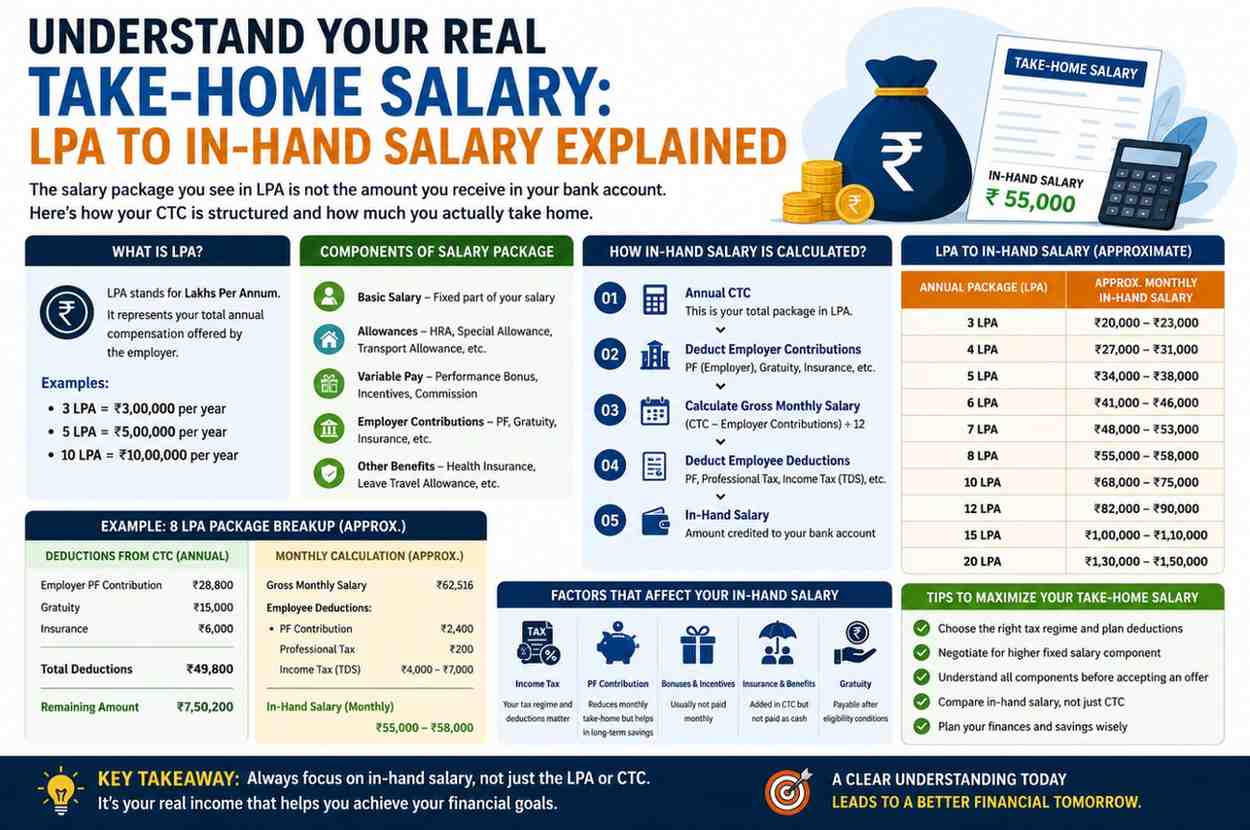
In the execution of recruiting process, even the commercial facility reserved for jobs are usually quoted as LPA (Lakhs per Annum), implying the fresher will earn Z lakhs per years. As alluring as a job offer can appear on paper, the number that gets deposited in your bank account each month can differ quite widely from what was offered. CTC, gross salary, net salary & in-hand salary — Learn About Them to Protect Your Career Choices and the Finances
This all-in-one guide tells you how to convert LPA in to actual take-home salary, what affects your monthly income and practical examples for how you can get an approximation of your real salary that you generate each Month.
What Does LPA Mean?
LPA stands for Lakhs Per Annum: It is the total annual salary that a company offers you in India. It signifies the total pay package provided to a full-time employee during one calendar year.
For example:
3 LPA = ₹3,00,000 per year
5 LPA = ₹5,00,000 per year
10 LPA = Annual pay of 10,00,000 (10 lakhs) per annum
20 LPA = ₹20,00,000 per annum
But the LPA number itself is not equal to your post-tax salary. Employers offer several things as a part of the package. These include:
Basic Salary
House Rent Allowance (HRA)
Special Allowance
Performance Bonus
Provident Fund (PF) Contribution
Gratuity
Insurance Benefits
Other Perks and Benefits
Hence, the actual money that comes into your account every month is lesser than the LPA published by way of advertising.
Understanding Salary Structure
To calculate your in-hand salary, you must understand the major features of your pay package.
1. Cost to Company (CTC)
CTC is the sum total amount a company spends on an employee in a year.
It includes:
Fixed Salary
Employer PF Contribution
Gratuity
Bonuses
Insurance Premiums
Other Benefits
Just because the CTC is higher does not mean a greater in-hand salary since various components may NOT be paid every month.
2. Gross Salary
Gross salary is the actual amount you earn before deductions.
It includes:
Basic Salary
HRA
Allowances
Bonuses
CTC — Gross salary includes employer-side contributions and benefits.
3. Net Salary
Net salary is the actual amount credited after statutory deductions.
Common deductions include:
Provident Fund (PF)
Professional Tax
Income Tax (TDS)
Employee State Insurance (ESI), if applicable
Net salary is what is commonly known as the in-hand salary.
Knowing Salary in Hand from LPA
The process involves several stages:
Step 1: Find out the Annual CTC
Suppose your offered package is:
8 LPA = ₹8,00,000 annually
Step 2: Totalless Employer Contribution
CTC typically components deducted may be:
Employer PF: ₹28,800 annually
Gratuity: ₹15,000 annually
Insurance: ₹6,000 annually
Total employer-related expenses:
₹49,800
Remaining amount:
₹8,00,000 − ₹49,800 = ₹7,50,200
Step 3: Gross Monthly Salary
₹7,50,200 ÷ 12
= ₹62,516 per month
Step 4: Remove Employee Contributions
Employee PF Contribution:
₹2,400 per month
Professional Tax:
₹200 per month
Income Tax:
It depends on the regime of Tax you choose and also varies annually
Estimated deductions:
₹4,000–₹7,000 per month
Step 5: In-Hand salary
Approximate take-home salary:
₹55,000–₹58,000 per month
Therefore, 8 LPA package typically translates to a take-home salary of ₹55k-58k per month, depending on your pay structure and taxes.
Influencing Factors for In-Hand Salary
A number of factors play a role in how much money you actually receive, though.
Income Tax Regime
Currently, there are two tax calculation options available in India. The selected tax regime can have a major influence on monthly in-hand salary.
One structure may be beneficial for employees claiming exemptions and deductions, while those opting for tax slabs without frills might prefer another.
Gratuity is often part of the CTC that organizations give you.
It is not earned income but a future benefit, since employees only qualify after completing certain employment service requirements.
Insurance Benefits
Health insurance and group life insurance premiums are often incorporated into the salary package.
Such benefits provide value, but decrease the percentage of CTC that is available as direct cash compensation.
CTC vs In-Hand Salary Difference
Almost all professionals wrongly believe their monthly salary can simply be calculated by taking LPA and dividing by 12.
For example:
10 LPA ÷ 12 = ₹83,333
However, after accounting for:
PF Contributions
Gratuity
Tax Deductions
Insurance Costs
Other Employer Contributions
This means true take-home pay could be nearer to:
₹68,000–₹75,000 per month
Knowing this difference may help you avoid setting yourself up for disappointment when assessing job offers.
By Idea Bridge | Updated On: 01st March, 2023 How Freshers Can Evaluate Salary Offers
So, field freshers are only looking at the headline package. A better strategy is to look at the entire pay scheme.
Before accepting an offer, review:
Fixed Pay
Variable Pay
Bonus Structure
Employer PF Contribution
Gratuity Component
Medical Benefits
Tax Implications
In some cases, it may be possible for a lower CTC with a larger fixed component to have better monthly cash flows than a bigger package relying heavily on bonuses.
How to Make the Most of Your Take-Home Salary
Optimize Tax Planning
Minimize tax liability using liable deductions and exemptions as far as possible.
Understand Salary Components
Push for an above the average fixed component and not high variable pay.
Review Benefit Structure
All of these benefits seem extra and should be carefully evaluated in light of your overall financial goals.
Instead of CTC Compare Net Income
Compare expected in-hand salary instead of advertised CTC numbers when analysing multiple job offers.
Plan Long-Term Savings
Although PF deductions have a short-term effect on income, they encourage long term wealth generation and retirement security.
Common Misconceptions About LPA
Myth-1 : CTC is the salary you get
Fact: CTC comprises various indirect benefits and employer components.
Myth 2: High LPA = High Cash Inflow
Truth: Salary structure decides actual take home salary.
Myth No. 3: Bonuses Are a Guaranteed Monthly Income
Bonus relies on the performance of the overall company (and what it determines to be a bonus-eligible portion).
Myth 4: PF Is A Salary Cut
Reality: PF is a forced savings mechanism even though it accrues interest over time.
Conclusion
In-depth knowledge of LPA to in-hand salary conversion is important for precise planning and decision making regarding your career. CTC is a good high-level overview of total remuneration, but the real factor as to what you actually take home (in terms of spending power) later on depends on how much is credited to your account after all deductions.
Each part of the salary structure (taxes, provident fund contributions, gratuities in case of early retirement/death before retirement and bonuses/performance-based benefits etc.) Knowing all these factors will better prepare a person to negotiate salaries, budget intelligently and plan what one can realistically make in a month.
This way, by concentrating on genuine informal wages versus title CTC numbers, experts can go with better professions and construct a superior monetary future.
